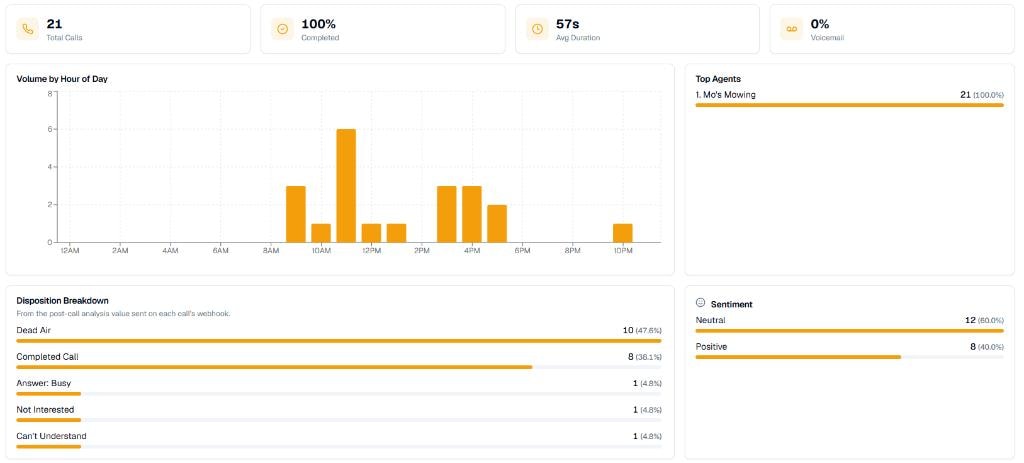
Real analytics dashboard -- Mo's Mowing, Victoria BC. September 2026.
Most landscaping businesses have no idea how many calls they are missing, what time of day their leads call, or which services are driving the most inbound interest. They just know the phone rings, sometimes they answer it, and sometimes they do not.
A monthly voice AI report changes that. Every call gets logged, categorized, and summarized -- so at the end of the month you have a clear picture of your lead volume, your peak call windows, and exactly what callers are asking for.
Below is a real report from one of our clients -- a lawn care and landscaping operator running under the name Mo's Mowing in Victoria, BC. Here is what the numbers show and what they mean for the business.
The top-line numbers
Total calls answered
Every one of these was a potential job. Without the AI, most would have hit voicemail.
Call completion rate
Not a single call dropped or abandoned. Every caller got a full conversation and a resolution.
Average call duration
Under a minute per call on average -- the AI qualifies efficiently without wasting the caller's time.
Voicemail rate
Zero calls went to voicemail. Every lead was captured live, not lost to a beep.
What this means: In one month, the AI answered 21 calls with a 100% completion rate and zero voicemails. For a solo operator or small crew, that is 21 potential jobs that would otherwise have been a coin flip -- answered or missed depending on whether you happened to be free.
When the calls are coming in
The volume-by-hour chart shows a clear pattern: calls cluster around mid-morning, spike again at lunch, and then build through the afternoon into the evening. The after-hours window -- 6 PM to 9 PM -- accounts for a significant share of total call volume.
10 AM
Peak morning window
12 PM
Lunch hour spike
2–4 PM
Afternoon steady flow
6–8 PM
After-hours surge
This is exactly the pattern green industry businesses see across the board. Homeowners think about their lawn while they are at work, call during their lunch break, and follow up in the evening after dinner. If your phone is not being answered during those windows, you are handing those leads to whoever picks up.
What happened on each call
The disposition breakdown is one of the most useful parts of the monthly report. It tells you not just how many calls came in, but what actually happened on each one.
Caller hung up before speaking -- likely robocalls or wrong numbers. Not lost leads.
Full conversations with real prospects. These are your qualified leads.
One call hit a busy signal -- worth reviewing your forwarding setup.
One caller declined service. The AI handled the rejection gracefully.
One call had audio quality issues. Consider reviewing your phone line settings.
The key number: 38% of calls were completed conversations with real prospects. On 21 total calls, that is 8 qualified leads captured in a single month -- without the owner answering a single call themselves.
What callers are asking for
The extracted variables section of the report shows exactly which services callers requested. For Mo's Mowing, lawn mowing dominated at 45%, followed by landscaping at 33%.
This kind of data is gold for a landscaping business. It tells you which services to feature in your marketing, which ones to price more aggressively, and where your capacity is being consumed. Without a voice AI report, you are guessing. With it, you are making decisions based on what your actual callers are asking for.
Sentiment and caller notes
The report also captures sentiment scores and caller notes -- things the AI picked up during the conversation that are worth knowing before you call back.
In this report, 60% of calls were neutral and 40% were positive. No negative sentiment was flagged. The caller notes section captured details like "caller has a big space for landscaping but is unsure of its specific use or design" and "caller has a dog that will be kept inside during service" -- the kind of context that makes a callback feel personal and prepared rather than cold.
Property details were also captured automatically: addresses, property sizes (one hectare, two hectares), residential vs. commercial classification, and whether the property was in the Greater Victoria area. By the time you pick up the phone to call back, you already know who you are calling and what they need.
What to do with your monthly report
Review your peak call windows
If most calls come in between 6 PM and 9 PM and you are not available, configure your after-hours routing so the AI handles those calls completely -- no transfer, no ring, just full intake and booking.
Track your completion rate
A 100% completion rate means every caller got a full conversation. If yours is lower, check your forwarding setup and your AI's fallback behaviour.
Use the service breakdown for marketing
If lawn mowing is 45% of your inbound calls, it should be prominent in your Google Business Profile, your website, and your ad copy. Let the data drive your positioning.
Read the caller notes before callbacks
The AI captures context you would otherwise have to ask for on the callback. Use it. Callers notice when you already know their situation.
Download the full report as a PDF
Share it with your team, use it for planning, or keep it as a record of your lead volume over time. The data compounds -- month over month, you will see seasonal patterns emerge.
Download the full guide
What a Monthly Voice AI Report Tells a Landscaping Business -- the complete PDF with data breakdowns, benchmarks, and action steps.
Get your own monthly report
See exactly how many calls you are getting, when they come in, and what callers are asking for -- starting this month.
See a live demo